
Key Takeaways:
- Some arguments in favor of free college include the ideas that it could help lower student debt, close income gaps, and reduce stress.
- However, it’s not quite clear where the funding would come from for free college, and there’s worries that it would diminish a degree’s value.
- Other programs, including targeted scholarships, free community college, and repayment plans, could make it easier for students to access and afford higher education.
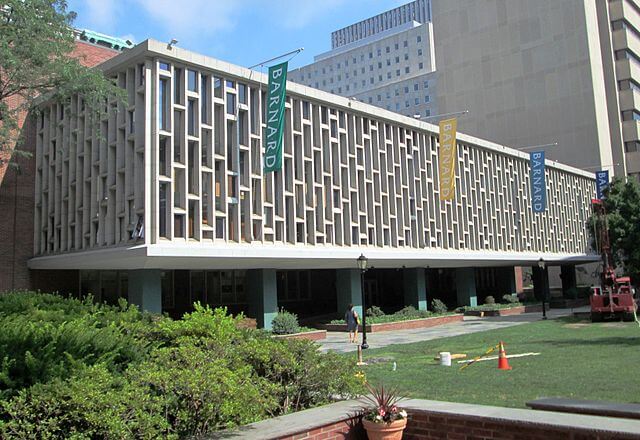
“2014 Barnard College Lehman Hall” by Beyond My Ken – Own work. Licensed under GFDL via Commons.
“Should college be free?” is an oft-asked question with a complicated and arguably unclear answer, especially in the face of rising college costs and student debt. Some argue, with evidence, that it could help close the inequality gap, encourage learning, and work to develop a better workforce. On the other hand, it’s not entirely clear where the funding for free college would come from or how it would affect the quality of high education.
Below, we broke down the possible benefits and the downsides to try to get to the answer of “Should college be free?”
Why Should College Be Free?
There are several upsides to making college free within the United States. It could bring a number of benefits to up-and-coming generations and students looking to return to college after a break. Here are six arguments in favor.

1. Student Debt Would No Longer Crush the Younger Generations
If an American college student is able to graduate with less than $10,000 in student loan debt, they are considered lucky (the current average is around $38,375 in federal student loan debt alone). Students from other countries that already offer free college don’t have much student loan debt, if any. Most of their costs are living expenses, books, and materials.
Without the weight of student loan debt, more college graduates could have the opportunity to buy houses and cars sooner rather than later. More money also makes it easier to afford healthier food options, healthcare, and basic needs.
And, of course, with less debt generally comes less stress. With 73% of people in the United States saying finances are the number one stress in their lives, the lack of student debt just as they’re entering the workforce could be a game changer for younger generations.
2. Free College Could Help Lessen the Current Inequality Gap
There are plenty of students who would love to go to college but simply can’t due to the excessive cost of attendance. Some even have to drop out because they don’t have the ability to pay for tuition for all four years – over 50% of students drop out of public universities because they can’t afford it! 79% also delay their graduation because they have to switch to part-time or return at a later date due to costs.
While there are grants and scholarship programs to help make college more affordable for these students, it sometimes isn’t enough and there’s only so much money to go around. Making college free could help eliminate this reason for not graduating and improve college graduation rates.
Other considerations include:
- There are income gaps between potential average earnings for college graduates and those with only a high school diploma.
- Those without college degrees are more likely to divorce.
- College expansion has been shown to decrease crime.
- College education has been shown to increase community participation.
3. More Freedom and Less Stress
When entering college, many students are concerned about the earning potential of their major. Additional pressure can come from parents, family members, and society as a whole. There’s also the concern about having a lucrative job after graduation so you can pay back that debt. These factors can result in students opting for “practical” majors that are much more geared towards income rather than their passions and interests.
In turn, burnout could occur when a student is taking courses that they’re simply not interested in, and financial concerns on top of this issue adds additional stress. If a student is constantly worried about affording their next semester’s tuition or working a job to afford their bills, they’re not focusing enough on their classwork. By allowing them to study what they want and taking the financial stress out of the equation, burnout is less likely to occur, resulting in higher grade potential and rising graduation rates.
4. More People Could Go to College
By negating the large cost of a college education, we could see an increase in the number of students able to attend college. Students who previously hadn’t thought about attending college due to the cost may now be interested in attending.
5. There Could Be a Stronger Workforce
College offers more than courses related to the student’s major and a chance to enter a specific career field. College education teaches several skills that can be difficult to master elsewhere. A range of available courses during the four years of college teaches students problem-solving, critical thinking, cooperation, communication, conflict resolution, networking, and more. These skills translate directly to the workplace which can improve productivity, efficiency, company culture, and overall performance.
6. It Could Help Drive Economic Growth
With free college there is potential to drive economic growth. If students graduate with little to no debt, they would have more money from their income to put back into the economy. And thanks to the skills colleges teach, employees can help build new companies and industries.
Why Should College Not Be Free?
However, there are some arguments that need to be noted that challenge the “college should be free” idea, including these:
1. The Money Has to Come From Somewhere
If America were to move to a tuition-free college policy, where would the money come from? The short and simple answer is likely in the form of increased taxes. So, who would be paying for those? It could impact the upper middle class as well as those in higher income brackets. Or it might come from Wall Street speculation taxes.
2. College Might Not Be Taken Seriously
A tuition-free college experience may result in an increase in students not taking it seriously. Some students state that the realization of how much they or their family is paying drives them to perform well in college and actually attend their classes. If college was free, students might be more likely to skip classes, change their major, and study less.
There’s also the concern that students would be more likely to take a course “here and there” rather than working towards degree requirements, which could take up valuable seats from those working towards a degree.
3. College Education and Experience Could Decrease in Quality
Another argument against “why should college be free” is the idea that quality could dip. With potentially less money going into colleges and universities, schools may find it more difficult to offer top-quality education opportunities for their students. Faculty and staff salaries could decrease, and colleges may find it difficult to afford new equipment or campus upkeep.
When students pay for their classes, they’re not only paying for their seat – the payments also go towards salaries, library books, housing repairs, campus resources, campus upkeep, and more.
4. More People Would Go to College
This was listed under the benefits of “why should college be free,” but the fact that more people would go to college could also be considered a downside. Some argue that free tuition means a college degree is worth less, resulting in lower pay for college graduates.
In addition, previous jobs that only required a bachelor’s could now require a master’s or higher, resulting in oversaturation and employees working jobs they’re overqualified for.
Plus, colleges only have so much space. Students might find it even more difficult to get into competitive colleges and waitlists could rise.
What Are the Other Conversations Around Free College?
There are a few other factors and conversations surrounding the idea of “free college” that aren’t arguments for or against, but still deserve a seat at the conversation.
If College Was Free, What About Private Institutions?
One concern is that if college is made free, we could see the decline of private schools. Since private schools rely on tuition and donations for a good portion of their funding (and their current endowment programs), they could find it difficult to compete with public colleges on a financial level. Would they have to close as a result, which in turn could lead to fewer seats for the influx of students, fewer job opportunities for professors, and the loss of research programs and projects?
What About Community College?
Some raise the point that not all types of college need to be free – what about just free community college? Many states already fund and offer free community college programs to their students. While many of these are dedicated to students within a certain income bracket, it’s opening the conversation more surrounding free community college for all.
Don’t Other Countries Offer Free College?
A point that is regularly brought up in favor of free college is the fact that many other countries manage to do it – why can’t we? Germany, Spain, Austria, Finland, Czech Republic, and France all offer free college to their students. In fact, Germany, Finland, Czech Republic, and France offer free education to all students, even those who aren’t residents.
These changes didn’t happen overnight, however, and the models took time to implement. Germany’s free tuition for public colleges, for instance, went under a tug of war for decades and it only became a tuition-free country in 2014. Even today, there are arguments against it. Although there’s a budget from Germany’s Ministry of Education to help fund the program, schools argue that the funding isn’t enough and they have to make up for the financing gap.
What Other Strategies Could Lower Student Debt and Increase Access to College?
Other strategies and programs could alleviate student debt while also increasing access to college. For example, income-driven repayment plans focus on making paying back debt more affordable for college graduates. At lower incomes, graduates have lower minimum payments. As income rises, their minimum payments also rise.
More targeted scholarships can also be a difference-maker. By offering grants and awards to students who are in the most financial need, they’ll be able to afford and access college.
Final Thoughts
So…should college be free? There’s a lot to consider, and it will likely be debated for years to come. Free tuition could definitely deliver plenty of improvements to society and open the doors to new opportunities for students. But there are challenges that would have to be solved before it could become a reality.
At the moment, while there are programs to help make college more affordable for students, college is not free in the United States. This means students need plans to help them cover the cost of tuition. One route that could help you graduate with less debt? Scholarships. And finding scholarships doesn’t have to be difficult! College Raptor’s Scholarship Search Tool helps you locate the awards you qualify for quickly. Use it for free right here.
Please note that the arguments made in this article are not the opinions of College Raptor®. Rather these arguments are meant to be a conversation showing the different considerations and arguments one could make.







Excellent article!
Very helpful for my research thank you I have cited you in my power point for school best one I have found with real info, once again thank you
This is a fantastic article! I love how it is split into pros and cons with a clear-cut and easy to understand format. The information is great as well!
Very good synopsis. I appreciate how you did not exhibit any biases one way or the other.
really good.
This is really helpful and so easy to inderstand all of this. It gives a good perspective when you put it into pros and cons and this is helping me on my essay a lot. Thanks so much.
Question: Isn’t the con about younger generations not know how to manage finances kinda biased? Just because tuition is free there are still plenty of other expenses like fees, books, meal plans, etc. And that’s not including the basic living expenses. So students would still have to budget, just one major load lifted but there’s still a cost of hundreds or thousands to be tackled. Just to address that tuition isn’t the only expense that makes college expensive
You are missing the point. You do not take out a loan to buy books, or eat or drive your car. Student loans are a note. If a student manages their student loans successfully chances are they can also be trusted with a car note or house note in the future. Student loans are reported to the credit bureau. In a single semester an individual may receive a federal Perkins loan at 5% and one or two Stafford loans at 6 to 9%, and most likely an endowment loan from the school itself. All appear separately on their credit bureau. If a student does not maintain the necessary grades required, and or fall below part-time student status, the loan is due. If it is not paid then the student can not return to school. Nor can they get an official copy of their transcripts to transfer to a different school that may be less academically challenging.
So, when it comes time to buy a house or a car or get a credit card, student loan history is a solid indicator of an individuals ability to manage the total package. As an executive headhunter, I can assure you it is a standard practice for companies to require a credit check as part of the screening process for employment. Your credit indicates how careful you will be.
Beautiful article!
You are god sent! This is exactly what I need for my argument!
i love you college raptor
You helped me do my English Essay! 😀
Thanks! This is my debate topic in class.
Thanks a lot! This is my research topic in class.
Personally I do not think that college free will make college become devalue. We all know huge benefits of getting bachelor’s degree. The more we learn, the more we earn and the higher the level of education, the lower the unemployment rate (Torpey, 2018). For instance, Torpey assums that median weekly earnings in 2017 for those with the highest levels of educational attainment—doctoral and professional degrees—were more than triple those with the lowest level, less than a high school diploma (2018). Although the cost of 4-year degree is increasing incredibly, people are looking for a way to make college affordable. Tuition and fees at a four-year public university averaged 9,410 dollars this past academic year (Anderson, 2016). Now a majority of Americans want to cut that price down to zero (Anderson, 2016). Sixty-two percent of Americans said that they support making public college tuition free for anyone who wants to attend (Anderson, 2016). Additionally, college free program will also have its own requirement and restriction. For example, according to Michigan State University website, a Spartan Advantage Program is offerred to cover all college’s tuition and fee for their students who can qualify their requirements such as being a dependent student, an entering freshmen with no prior college experience or a continuing student who received the award in the prior year, and eligible for the Federal Pell Grant. The most challenges are being a full-time students because they will not have an time extension to complete their education (Michigan State University). To illustrate, eligibility for the award is limited to 8 consecutive semesters, excluding summer sessions but including other semesters of non-enrollment (Michigan State University). After all, I think it is hard to keep the the plan on track all the time. Making an agreement to complete a bachelor’s degree on time of 4 years will be a big challenge. That requires students pay very close attension on their college and have a good plan to keep get a college free.
References:
Torpey, E. (2018). “Measuring the value of education”. Retrieved from https://www.bls.gov/careeroutlook/2018/data-on-display/education-pays.htm
Anderson, T. (2016). “Over 60% of Americans back tuition-free college”. Retrieved from https://www.cnbc.com/2016/08/01/over-60-of-americans-back-tuition-free-college-survey-says.html
Michigan State University, “Spartan Advantage Program”. Retrieved from https://finaid.msu.edu/spad.asp
This is so helpful for my upcoming debate. Thank you so much. Very helpful.
Good information i was helping my kid with an essay and this source was the best
Very helpful good source of information
Very helpful I need this for my argumentative essay.
Replying to “The money has to come from somewhere”. Of course, the money would far more than likely come from taxes. This is simply commonly known. There are almost no other ways to raise the money. Therefore I would be forced to say that you are right. However, you are wrong to say that this would be a con. The money would indeed need to come from Wall Street companies and industries otherwise it would take at least 23 years to make up the $2.2 trillion in student debt, putting most tax payers into increased financial burdens. On the other hand, if we were to tax 0.05 % (50 cents per $100) on Wall Street stock trades, as Bernie Sanders wants to do, then we could raise $2.4 trillion in only 10 years. There is much more to discuss, but I’ve only researched this much so far.
People in Germany don’t have to pay for college and they know how to budget and buy things responsibly. My friend wasn’t able to go to college or my parents and they are good with money. I think life shows you how to be good with money or you are just bad with money and college will not help.