College Match
The Right College. The Best Price.®
Get college matches based on GPA, majors, location, test scores, and culture. For the most accurate results, have the following information available: student’s income and assets, parents’ income and assets, high school GPA, and SAT or ACT score.

Understanding Your Matches
Net Price vs Sticker Price
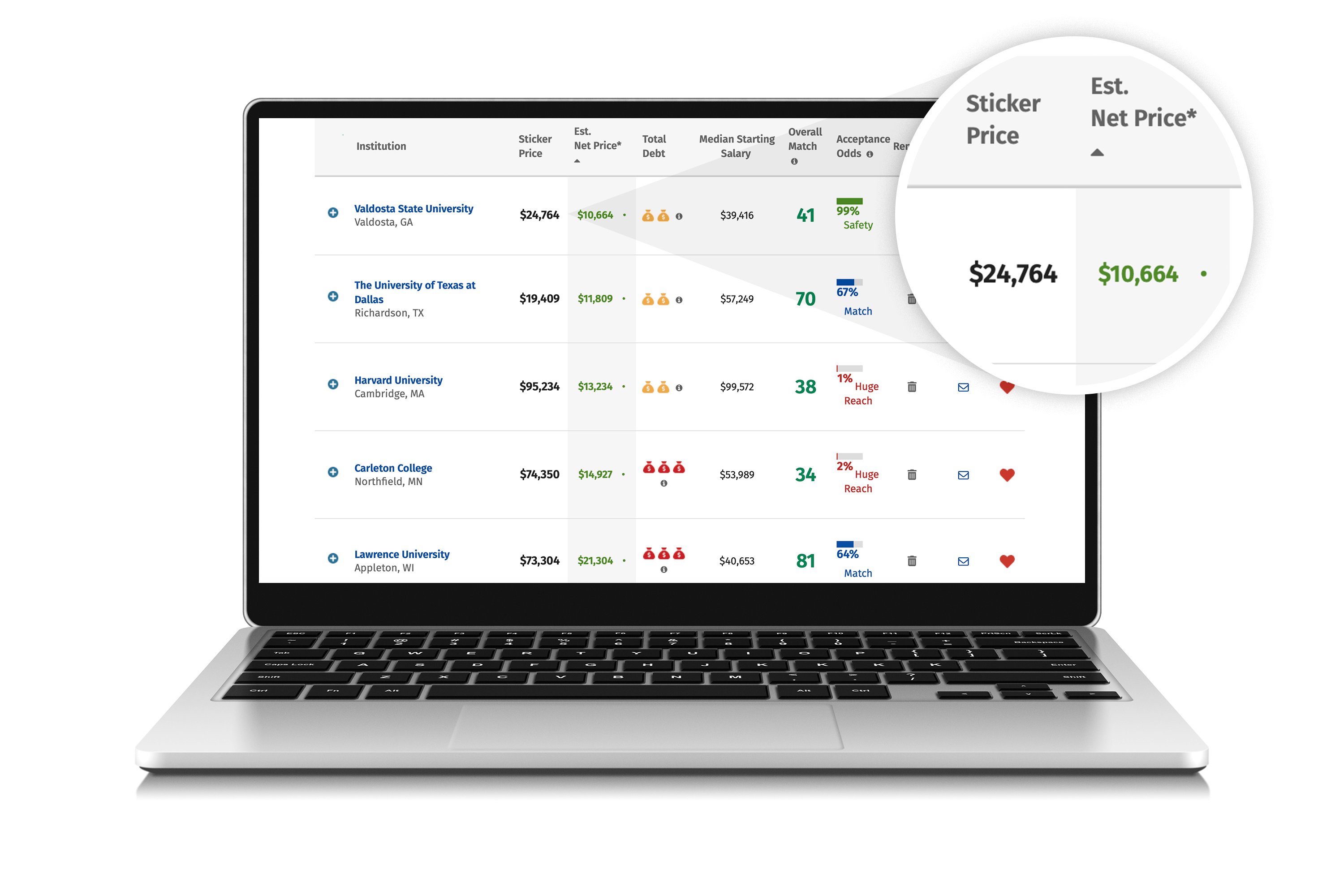
We estimate a student’s net price at any 4-year college in the U.S. This is important because the net price a student or family pays can often be dramatically less than the sticker price shown on a college’s website.
We estimate the amount of federal grants, institutional grants, and merit scholarships that you may qualify for at each college to help cover expenses. So, when comparing the costs of different colleges, you should consider your net price, not the sticker price.
Prices shown are our best estimates. They are not perfect but are generally close to the net price estimate on a college’s official net price calculator (NPC).
All prices are per year and calculated for full-time students living on campus.
Match Categories
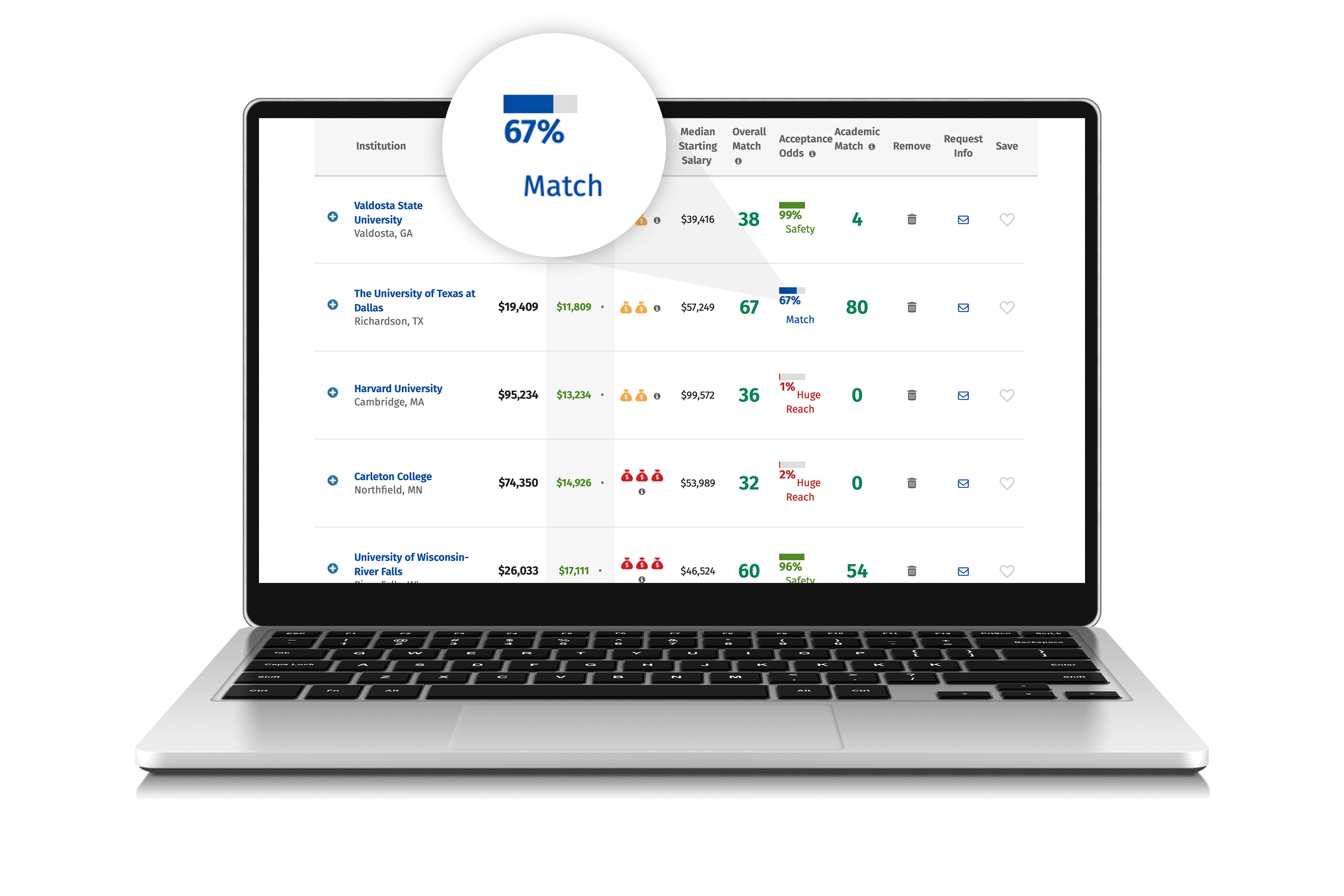
College matches will be organized into one of five match categories: “Safety,” “Near Safety,” “Match,” “Reach” or “Huge Reach.” These categories are based on your estimated admissions chance at that particular college.
Some colleges—particularly very selective colleges like Ivy League schools—will be categorized as a “Huge Reach” for all students, including those who match their academic profile. This is because even for well-qualified students, it’s still very difficult to get accepted to these colleges.
View Demo
Watch a full demonstration of how to utilize College Raptor’s College Match tool.
Admission Chances
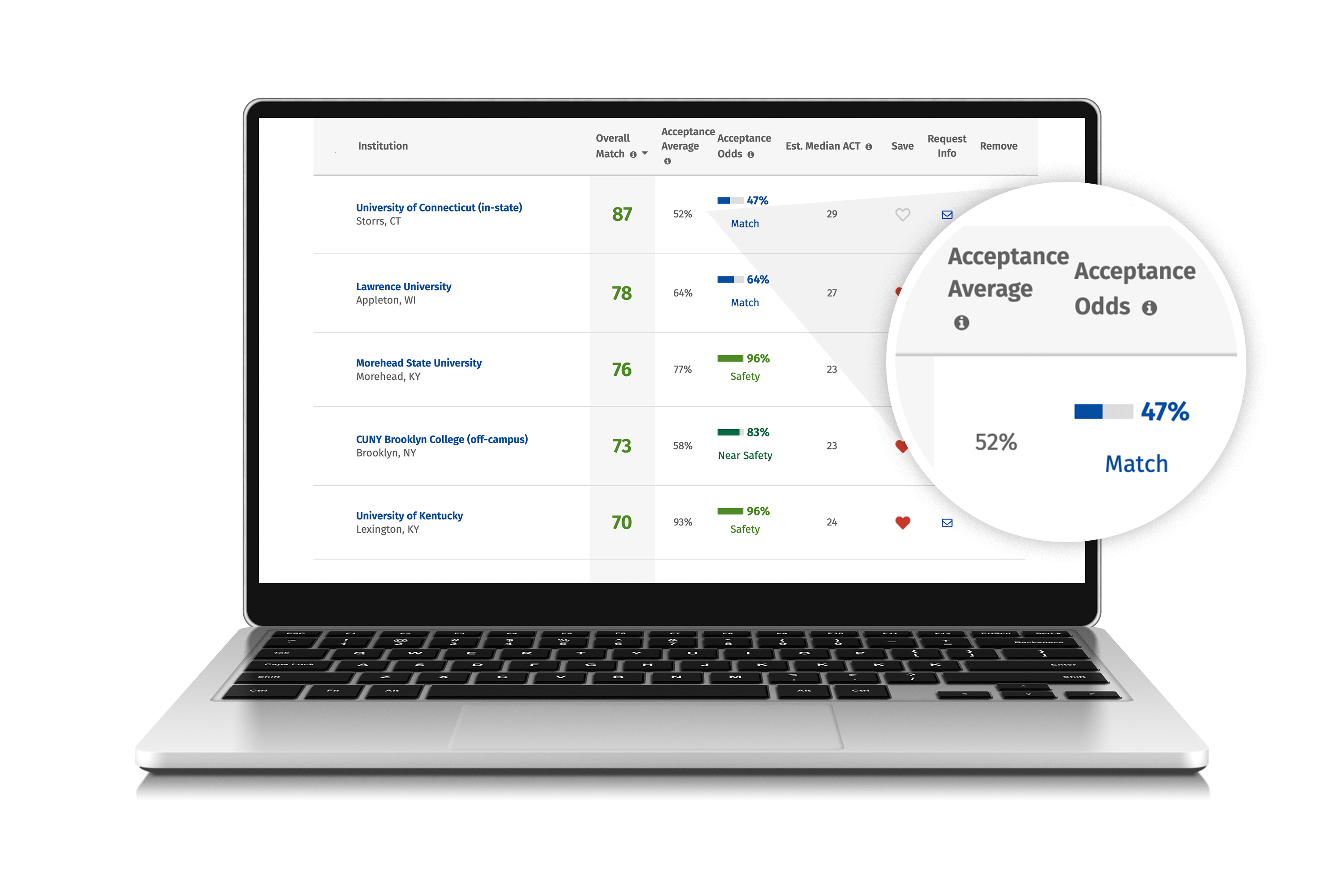
Estimated admissions chances are based on a combination of the student’s academic information and the overall acceptance rate of a college.
These chances are our estimates and may be different for each student, based on their individual coursework, class rank, and other factors that we do not currently include in our calculations.
Match Scores
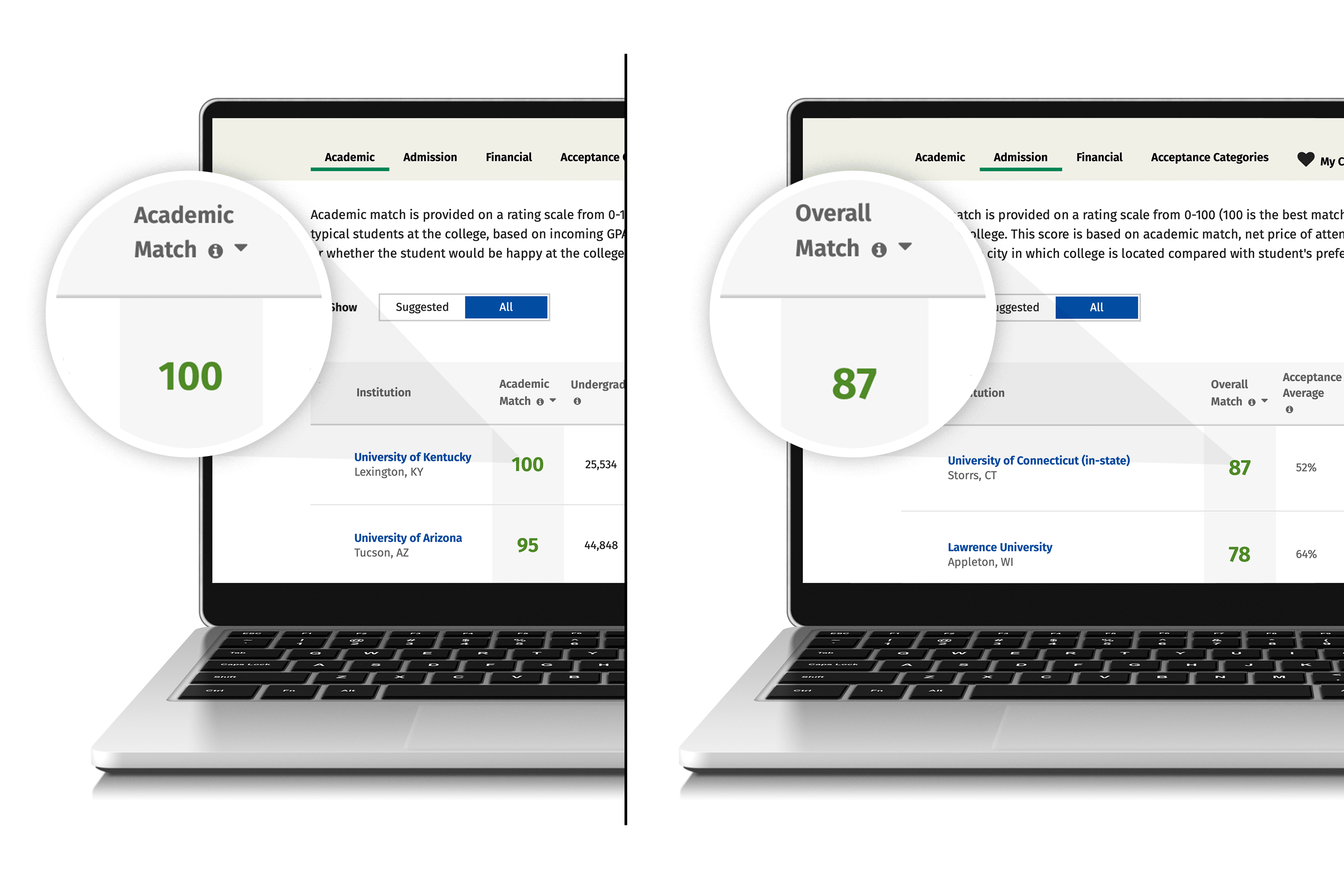
College Raptor calculates two types of match scores: Academic Match and Overall Match.
Academic Match scores are based on academic criteria of the student versus the college’s average student profile and the student’s preferred majors. Overall Match scores include Academic Match, plus cultural and location preferences.
Start using our free college planning tools by registering today!
FAQs for finding your right college
In most cases, you'll want to begin your college search your junior year in high school. Early preparation gives you time to improve your application, explore all your options, and meet important deadlines. As you begin your search you'll want to:
- Identify your specific preferences—what's important to you. What matters most to you in a college: desired major, campus size and location, extracurriculars, financial situation, and cultural fit. Use guiding questions to clarify your goals and keep a running list of your answers.
- Talk to people who know you best. Meet regularly with your high school counselor, coaches, teachers, or college admissions advisor. They offer valuable insights, school recommendations, and application tips tailored to your needs.
- Attend college fairs. College fairs are excellent for gathering information and asking questions directly to college representatives. Look for events at your school, local colleges, or convention centers.
- Use college search tools. Leverage online tools like College Raptor’s College Match to find schools that fit your criteria. These platforms help you build a list of safety, match, and reach schools, and allow you to adjust preferences as needed.
- Compare colleges. Create a comparison spreadsheet to evaluate schools based on major quality, financial aid, campus features, statistics, and student feedback. This helps you narrow down your choices and track deadlines.
- Take campus tours. Visit college campuses in person or take online tours to get a feel for the environment.
- Use additional resources to make your final decision. College Raptor has tools to help you explore majors and careers, find scholarships, and compare financial award letters. These resources can help you narrow down your choices and provide clarity in making your final college decision.
Once you’ve started your college search, it’s time to narrow down the list. So how do you choose what’s right for you from your big list?
- Make sure the school has the programs and resources that are most important to you. Do they have your intended major? Is it the right size/location? Does it feel good to you?
- Visit the colleges again if possible. Being on campus really gives you a feel for your next four years.
- Talk to alumni and current students. Ask questions from the people who’ve been there.
- Compare all your options. Using a spreadsheet can help you track which colleges have all the things that matter to you. See which colleges meet your top criteria.
- Cost matters, so once you’ve narrowed your list, compare offer letters to see which school is giving you the best deal.
- If you still have questions about cost and award letters, contact the school’s financial aid office.
Once you’ve made that final decision, let the school know you’re accepting their offer!
College admissions officers love a well-rounded student, and your college applications should reflect that. To put your best foot forward, focus on these key factors:
- Academic achievements. Aim for high ACT or SAT test scores and solid GPA. Also highlight any AP courses you are taking to show academic rigor.
- Nail your application essay. This is your best shot at letting your personality shine through. Even if your test scores or GPA aren't outstanding, a strong essay can turn an average application into an impressive one.
- Highlight extracurriculars and demonstrated leadership. These activities show the college who you are outside of the classroom.
- Get a letter of recommendation. Ask a teacher, counselor, coach, or anyone who knows you well to write a recommendation letter supporting what a great person you are.
- Clean up your social. This may not be part of the actual application, but some schools do look at your social media. So, make sure you’re proud of what you’re posting.
- Consider Early Action or Early Decision. If you are very intent on a specific college, applying EA or ED could boost your acceptance odds.
Once you think you’re ready to submit those applications, make sure you (or a parent or counselor) re-read and edit your application for accuracy and make sure you’ve followed the school's guidelines.
Different colleges excel in different areas. To find out the top colleges by major, head over to our majors search tool.
Search for the majors that interest you most. Click on that major and you'll see:
- the top schools and programs for the specific major
- learn more in depth information about the major
- explore careers and growth projections related to the major
- see demographic information on students pursing the major
Explore majors and top schools for each major.
The top colleges in the US are ranked annually based on data about the school’s selectivity, financial health, graduation rates, student success and more. College Raptor’s T20 schools are:
- Princeton University
- California Institute of Technology
- Harvard University
- Yale University
- Massachusetts Institute of Technology
- Stanford University
- University of Chicago
- University of Pennsylvania
- Duke University
- Dartmouth College
- Brown University
- University of Notre Dame
- Pomona College
- Northwestern University
- Vanderbilt University
- Rice University
- Amherst College
- Williams College
- Swarthmore College
- Johns Hopkins University
These best 20 colleges are rich in history and prestige and are dream schools for many.
College Raptor recommends that students and families use college rankings (and College Raptor's Hidden Gems lists) only as a jumping-off point in your own college search. Your college list should be tailored to fit your academic profile, career goals, budget, and more. Start building your own “best colleges” list today with the College Match tool.

From classroom to career, the Citizens Student Hub offers tools, advice, and resources built around real-life stages — from high school through college and beyond.

Subscribe to Our Newsletter
Join thousands of students and parents learning about finding the right college, admissions secrets, scholarships, financial aid, and more.