Key takeaways:
- While most middle-class families won’t qualify for the full Pell Grant amount, there are other sources of financial aid that can make college more affordable.
- To maximize financial aid, complete the FAFSA each year, apply for scholarships, and don’t rule out private colleges.
- You can further lower the cost of college by attending community college first, leaving the car at home, and buying used textbooks.

Source: Flickr user 76657755@N04.
Many middle-class families run into the question of “How do we afford this?” after their future college student starts comparing schools and their prices. They often make too much to qualify for demonstrated financial need programs, such as the Pell Grant and institutional grants, and are expected to make up the difference between any financial aid they’re offered and what they need out of savings. However, there are ways to lower the overall cost of college, including financial aid for middle-class families.
How middle class families can find financial aid for college
These six strategies can help you find financial aid and make college more affordable.

1. Complete the FAFSA
Always complete the Free Application for Federal Student Aid (FAFSA) every year on or shortly after October 1, even if you don’t think you’ll qualify for anything. Income minimums change all the time, and colleges are constantly adding new institutional aid programs. You might receive additional aid this year even if you didn’t last year.
Many colleges won’t consider you for merit scholarships either if you don’t complete the FAFSA.
Some schools require the CSS Profile instead of or with your FAFSA. Head to your colleges’ financial aid office websites to review their policies, available awards, and important deadlines.
2. Don’t rule out private colleges
While public colleges often have lower tuition rates than private schools, they don’t have the same institutional aid available. As a result, some private colleges and universities are in a better position to hand out large financial aid packages. Some schools, such as Harvard University, Caltech, and MIT, offer free attendance to accepted students whose families make less than $100,000, and significantly lower costs to those who make between $100,000 and $200,000.
Always look past the sticker price. Net price calculators and College Raptor’s College Match can help you get estimates of how much you can expect to pay to attend any particular college.
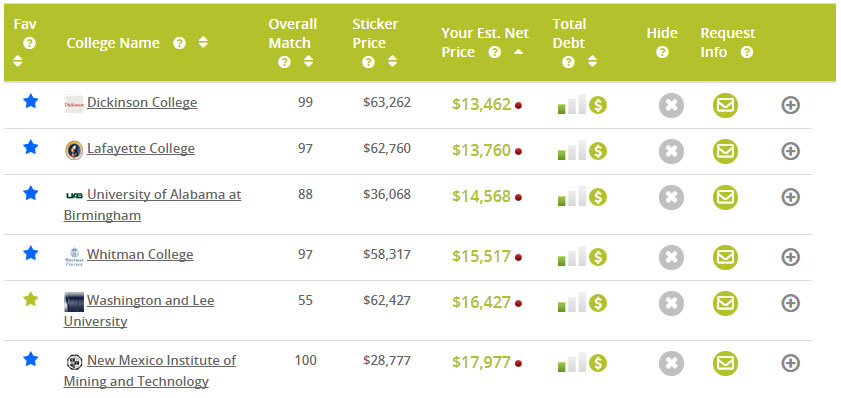
College Raptor results page
3. Apply for grants and scholarships
Scholarships are considered gift aid and don’t need to be paid back as long as you meet any requirements that come along with the awards. You could qualify due to high grades, solid standardized test scores, volunteer work, or even your hair color. Some awards are only a few hundred dollars, but they can add up. Others are $10,000 or more. Scholarships come from colleges, nonprofits, businesses, and more.
Many states offer grants to students who qualify as well. Like scholarships, they don’t generally need to be paid back.
You can find these awards through online scholarship databases, your state’s higher education department, your college, high school guidance counselor office, local companies, and other sources.
4. Invest in academics
A higher GPA or standardized test score could equal big bucks. You’ll qualify for higher merit awards and could get accepted to a college with a larger endowment. Even just a few extra points on the ACT or SAT could mean thousands of dollars.
For example, through Florida’s Bright Futures program, a 28 ACT and a 3.4 weighted GPA means you’ll receive a scholarship that covers 75% of your tuition and fees at a public school in the state. However, a 29 ACT with a 3.5 weighted GPA makes you eligible for 100% covered tuition and fees at a Florida public school.
It’s likely worth your time (and money) to invest in tutoring for your classes and your ACT/SAT tests.
5. Appeal offer letters
Financial aid offer letters may come in a variety of formats that make them confusing, but they’re rarely written in stone. Many schools allow you to appeal financial aid decisions, especially if your financial situation has changed since the fiscal year the FAFSA pulled from.
Review your college’s policies to learn how to appeal the offer for more aid. It helps to have other financial aid offers in hand before you make the call – it gives you some negotiating power. Always be polite and factual.
6. Review the most affordable colleges for middle-class
College Raptor releases its Top Colleges rankings each year, including the top schools for middle-class affordability. It accounts for typical financial aid for a family of four with one child in college, a total income of $80,000, and $50,000 in assets.
You can review typical net prices for middle-class families by state or by major.
More tips to lower the cost of college
While the strategies above can help make college more affordable and help middle class families garner more financial aid, there are a several other ways to help lower the cost:
- Attend in-state. If you have your heart set on a public school, an in-state college is going to have a much more affordable rate than an out-of-state institution. You can also look into tuition reciprocity programs which provide in-state tuition to students from nearby states.
- Consider community college first. The average annual cost of community college is $13,282, compared to $38,270 at a 4-year institution. Attending a 2-year school first could save you money long term.
- Take AP or dual enrollment classes in high school. AP and dual enrollment classes through your high school are a fraction of the cost of what you’d pay at your college. Taking the classes might even help you graduate college a semester early if you take enough.
- Check with your employers or your parents’ employers. Some businesses offer tuition assistance programs to their employees or their employees’ children.
- Buy used. Some college textbooks can cost hundreds of dollars, so opting for used or digital editions can add up.
- Skip the car. Campus parking can be expensive, not to mention gas and maintenance. Many schools have public transportation and driving isn’t necessary.
- Review room and board plans. You likely don’t need the top of the line meal plan or housing. Research your options to identify the best deal.
- Compare your financial aid offer letters. Financial aid award letters come with or shortly after acceptance letters, but they don’t follow a single format. It can be tough to identify the best deal. Use a Financial Aid Offer Comparison tool to determine which school is offering you the most money and bang for your buck.
Ready to get started? Explore all the different ways—scholarships, grants, federal aid—you can help pay for college. Visit the Citizens Student Hub today to get started.