Key takeaways:
- The four most common grad school exams are the GRE, GMAT, MCAT, and LSAT.
- Some fields require specialized exams like the DAT for dental school or the OAT for optometry.
- International students applying to U.S. grad programs typically need to submit proof of English proficiency.
- Not all grad schools require entrance exams since some programs have shifted to test-optional or holistic admissions.
- Starting your test prep at least three to six months in advance may significantly improve your score.

Flickr user clemsonunivlibrary
If you’re planning to apply to graduate school, chances are you’ll need to take at least one standardized entrance exam. Just like the SAT or ACT opened the door to your undergraduate degree, graduate entrance exams help programs evaluate whether you’re ready for advanced academic work.
The most common types of grad school exams are the GRE, GMAT, MCAT, and LSAT. Which one you need depends on the graduate program you’re applying to. Some programs also require specialized exams like the DAT or OAT. International students may need to submit TOEFL or IELTS scores to show English proficiency.
The good news is that these exams aren’t as mysterious as they might seem. Once you know which test applies to your program and what to expect on test day, you can prepare with confidence.
The four major grad school exams

GRE (Graduate Record Examinations)
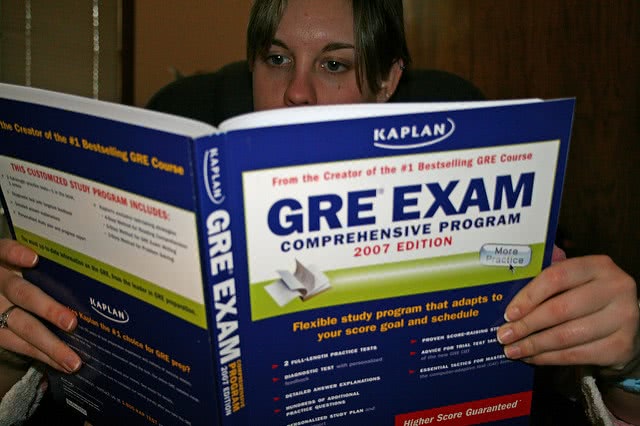
The GRE is the most widely accepted graduate entrance exam in the United States. It’s administered by the Educational Testing Service (ETS). It is required by a broad range of master’s and doctoral programs across many fields, including education, social sciences, humanities, and various sciences.
The exam is 1 hour and 58 minutes long. It includes 55 total questions across five sections:
- Verbal Reasoning: 2 sections, 27 questions, 41 minutes
- Quantitative Reasoning: 2 sections, 27 questions, 47 minutes
- Analytical Writing: 1 essay, 30 minutes
The registration fee is $220. Rescheduling costs an additional $55. GRE scores are valid for five years, so you have some flexibility.
ETS also offers GRE subject tests in fields like psychology, physics, and mathematics. These may be required or recommended by certain grad school programs.
GMAT (Graduate Management Admissions Test)
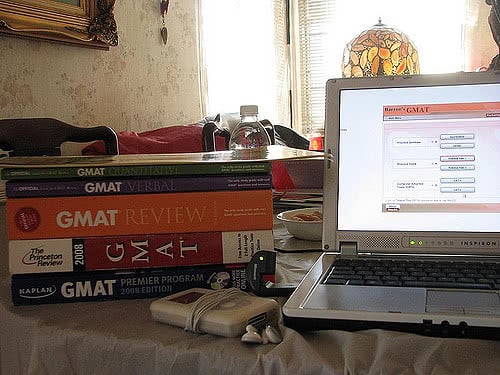
The GMAT is the go-to grad school exam for students applying to MBA programs and other business school programs. It’s overseen by the Graduate Management Admission Council (GMAC).
The GMAT takes 2 hours and 15 minutes and includes 64 total questions across three sections:
- Quantitative Reasoning: 21 questions, 45 minutes
- Verbal Reasoning: 23 questions, 45 minutes
- Data Insights: 20 questions, 45 minutes
Registration fees range from $275 to $300. Rescheduling fees vary from $55 to $180, depending on how close you are to your test date. Some business schools also accept the GRE instead of the GMAT, but it’s important to double-check your school’s requirements.
MCAT (Medical College Admissions Test)
The MCAT is needed for admission to medical school and is administered by the Association of American Medical Colleges (AAMC). It’s designed to see whether future medical students have the scientific knowledge and critical thinking skills needed to attend medical school.
The MCAT is a half-day test with four sections:
- Biological and Biochemical Foundations of Living Systems
- Chemical and Physical Foundations of Biological Systems
- Psychological, Social, and Biological Foundations of Behavior
- Critical Analysis and Reasoning Skills
The exam takes about 7.5 hours, including breaks. MCAT scores range from 472 to 528. The AAMC offers a Fee Assistance Program for students who may have difficulty covering exam costs.
LSAT (Law School Admissions Test)
The LSAT is administered by the Law School Admission Council (LSAC) and is required for admission to most ABA-accredited law schools. It measures reading comprehension, logical reasoning, and analytical reasoning skills that are important for law school.
The LSAT takes approximately 2 hours and 30 minutes to 3 hours and includes four sections:
- Logical Reasoning: 2 sections, 24-26 questions each, 35 minutes each
- Reading Comprehension: 26-28 questions, 35 minutes
- Unscored Section: 24-28 questions, 35 minutes (used to test future exam questions and does not count toward your final score)
- Writing Sample: 1 essay, 35 minutes (not scored but sent to law schools)
An LSAT score is an important part of the admissions process. Law school applications are competitive, and LSAT scores are publicly recorded. Because of this, schools consider how an applicant’s scores could impact the academic profile of an incoming class. Scores range from 120 to 180.
Other specialized grad school exams
Depending on your field, you may need to take a more specialized exam rather than one of the four listed above.
- DAT (Dental Admission Test): Required for dental school applicants. It tests academic ability, scientific knowledge, and perceptual ability.
- OAT (Optometry Admission Test): Required for optometry school applicants, covering natural sciences, reading comprehension, physics, and quantitative reasoning.
- PA-CAT (Physician Assistant College Admission Test): A newer exam specifically for PA programs. While many PA schools still accept the GRE, more are switching to the PA-CAT to better test knowledge of medical science.
English proficiency exams for international students
International students applying to grad schools in the United States are usually required to submit proof of English proficiency. The two most commonly accepted exams are:
- TOEFL iBT: Administered by ETS and widely accepted at U.S. institutions
- IELTS: Accepted at most U.S. universities and required by some programs that don’t accept the TOEFL
Tips for preparing for grad school exams
No matter which exam you’re taking, preparation makes a difference. Here are a few study tips to keep in mind:
- Start early: Most test prep experts recommend giving yourself at least three to six months to prepare.
- Take practice tests: Timed practice tests under realistic conditions are one of the best ways to build familiarity and improve your score.
- Use official prep resources: Each testing organization offers official study guides and practice questions. Resources like Khan Academy also offer free prep for some exams.
- Build a study schedule: Break your prep into manageable chunks and stick to a consistent routine rather than cramming.
- Manage test-day nerves: Practice deep breathing, get a full night’s sleep before test day, and practice healthy eating and drinking habits. Remind yourself that you can retake most of these exams if needed.
How do grad school exams differ from undergraduate exams?
Undergraduate exams like the SAT and ACT measure broad academic ability across all high school students. Grad school standardized tests are more targeted. They look at skills relevant to specific fields. For example, they consider analytical reasoning for law school or scientific knowledge for medical school. Many are also harder to prepare for quickly, which makes starting early especially important.
Another key difference is that not all grad schools require entrance exams. Some programs have moved to test-optional or holistic admissions. They look more heavily at factors like work experience, professional experience, undergraduate GPA, and letters of recommendation. Always check the specific requirements of each program before registering for a test.
What comes next
Once you’ve identified which grad school exams you need to take and have a study plan in place, it’s time to think about where you want to apply. Use College Raptor’s College Match tool to explore graduate programs that align with your goals. Check out the Career Finder to make sure the path you’re pursuing matches the future you’re working toward.