Key takeaways:
- Harvard University is a top ranked institution in Cambridge, Massachusetts, dating back to 1636.
- Undergraduates attend Harvard College, one of the 13 schools that make up Harvard University.
- Harvard is extremely selective, with an undergraduate acceptance rate of 3.7%

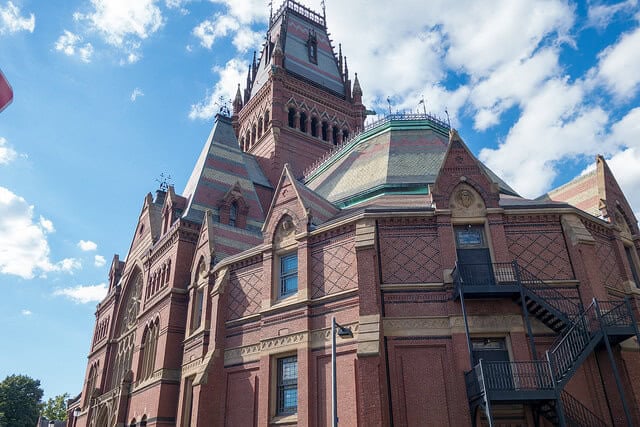
Chensiyuan via Wikimedia Commons
You might use “Harvard College” and “Harvard University” interchangeably, but they’re actually slightly different. Harvard College is the undergraduate school at Harvard University and just one of 13 schools that make up the entire university. We know it’s a bit confusing, so we dove into the specifics below to explain Harvard College vs. Harvard University.
Harvard College vs. Harvard University
Harvard University is an entire institution made up of 13 colleges and schools including Harvard College, the undergraduate school. If you’re pursuing a bachelor’s degree at Harvard, you’re attending Harvard College at Harvard University. If you’re pursuing a Master’s, Doctorate, or Professional degree, you’re attending one of the other 12 schools at Harvard University.

What is Harvard College?
Harvard College was founded in 1636, the first college in the American colonies. It was named for John Harvard three years later, who willed half of his estate and library to the school when he died in 1638. The school was recognized as a university in 1780.
Today, Harvard College is the liberal arts, undergraduate college and one of 13 colleges and schools at Harvard University. It awards Bachelor of Arts and Bachelor of Science degrees. If you’re earning a bachelor’s at Harvard, you’re taking classes through Harvard College.
Alumni of Harvard College include John Adams, Ralph Waldo Emerson, Henry David Thoreau, Franklin D. Roosevelt, Helen Keller, John F. Kennedy, and J. Robert Oppenheimer.
What is Harvard University?
Harvard University is an Ivy League and private research institution, awarding up to Doctorates. It consists of 13 schools, including Harvard College for undergraduates and 12 graduate and professional schools. Each school is independent of one another, with separate admissions and teaching facilities.
The 12 graduate and professional schools that make up Harvard University with the undergraduate college are:
- Harvard Business School
- Harvard Divinity School
- Harvard Extension School
- Harvard Graduate School of Design
- Harvard Graduate School of Education
- Harvard John A. Paulson School of Engineering and Applied Sciences
- Harvard Kennedy School
- Harvard Kenneth C. Griffin Graduate School of Arts and Sciences
- Harvard Law School
- Harvard Medical School
- Harvard School of Dental Medicine
- Harvard T.H. Chan School of Public Health
The university also includes the Radcliffe Institute for Advanced Study at Harvard University, which focuses on fostering research.
Quick facts about Harvard University
Here are some things you should know about Harvard College and Harvard University:
- Location: Cambridge, MA
- College Raptor’s 2026 Best Colleges – Overall Ranking: #2
- Number of undergraduates: 7,038
- Undergraduate acceptance rate:7%
- Undergraduate yield: 83.3%
- Average accepted ACT score: 34 – 36
- Average accepted SAT score: 1,500 – 1,590
- Number of graduate students: 21,291
- HBS MBA acceptance rate: 15%
- HBS Doctoral acceptance rate: 4%
- Average LSAT score for HLS: 174
- Number of alumni: Over 400,000
- Average undergraduates grant aid: $64,942 per student
- Percentage of undergraduates receiving grant aid: 57%
- Most popular major: Econometrics and Quantitative Economics
- Most popular Master’s program: Business Administration and Management
- Most popular Doctoral/Professional program: Law
Whether you’re applying for a Bachelor’s, Master’s, Doctorate, or Professional degree, Harvard University is an extremely selective school – one of the most selective in the country. Harvard receives so many applications, it simply can’t accept all of the qualified students. It’s also one of the best. To improve your chances of an acceptance letter, you need to focus on academic rigor, your community, leadership, high grades, top SAT/ACT score, outstanding essay, and more.
Want to learn more about your admission chances and how you stack up against other students applying to Harvard? Get started with College Match to start exploring Harvard College, Harvard University, and thousands of other schools throughout the United States.