Key takeaway
- Veterinarians are trained doctors who specialize in taking care of animals in clinics, zoos, farms, or labs.
- Becoming a licensed vet takes between eight and 10 years, where you’ll need to earn a bachelor’s degree, apply to a vet program, complete clinical rotations, earn your degree, pass your exam, and register with your state.
- Below you’ll find stats on 10 of the best vet colleges in the U.S., including Iowa State University, Colorado State University-Fort Collins, Virginia Polytechnic Institute and State University, Kansas State University, North Carolina State University at Raleigh, University of California-Davis, Cornell University, Ohio State University, University of Pennsylvania, and Texas A&M University.
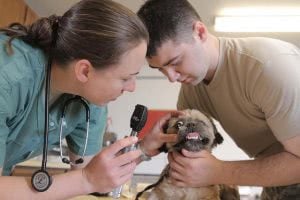
Flickr user Army Medicine
Becoming a veterinarian is a challenging, but extremely rewarding journey. It typically requires eight to 10 years of education after you graduate high school, and with just over 30 accredited veterinary schools in the United States, admissions are highly competitive. You’ll need to be prepared if you dream of becoming a vet and applying to one of these best vet colleges in the U.S.
What does a veterinarian do?
A veterinarian, or vet, is a doctor who specializes in the care and treatment of animals. Just as we rely on doctors to support our quality of life, animals depend on veterinarians to keep them healthy and safe from diseases. Vets may work in clinics, zoos, research labs, or with farm animals. They’re trained to:
- Diagnose and treat illnesses
- Perform surgery
- Prescribe and administer medications
- Interpret test results
- Provide advice to pet owners and caregivers
- Develop specialized diets
- Provide preventative care

Steps to becoming a veterinarian
Becoming a veterinarian requires years of dedication. Veterinary schools are extremely competitive and only select the top students. Because of this, the journey to becoming a vet starts in high school, where transcripts, extracurriculars, and a strong personal statement are all needed to get into a high-ranking four-year college.
Note: The Veterinary Medical School Admission Requirements can help you determine what you need to do when, but here’s a quick glance at what you can expect over the next eight to 10 years.
1. Attend college
Students interested in becoming a veterinarian will need to go to the right college and pursue a relevant physical or biological science major, such as zoology, biology, animal science, or organic chemistry. Veterinary schools also require specific prerequisite courses in order to be accepted, ranging from biology and math to English and business.
2. Gain relevant experience
Before you step foot in a veterinary school, you should have relevant experience in the field. You can opt for internships at your local veterinarian’s office, job shadowing, volunteer work at animal shelters, or extracurriculars related to animals and their care.
3. Apply to veterinary programs
Veterinary programs are highly competitive, so you’ll need a strong application with a strong GPA and a good Graduate Record Exam (GRE) score. While a GRE score of 330 or higher is considered above the 90th percentile, anything over 160 is still considered to be competitive. Many vet programs also require letters of recommendation, volunteer work, and a personal statement.
4. Earn your Doctor of Veterinary Medicine (DVM) degree
If you’re accepted, you’ll spend the next four years earning your Doctor of Veterinary Medicine (DVM) degree. The first two to three years will be focused on coursework in the classroom and labs, depending on the program. Courses include radiology, animal behavior, pharmacology, veterinary practice, and more. The final one to two years are dedicated to hands-on experience with clinical rotations.
5. Pass the North American Veterinary Licensing Examination (NAVLE)
In order to practice as a vet, you’ll need to pass the North American Veterinary Licensing Examination (NAVLE) during the fall or spring semester of your final year. Those who take it in the fall can take it a second time in the spring. Without passing this exam, you can not practice veterinary medicine.
6. Register with your state
Once you have your DVM and have passed the NAVLE, you’ll need to register with your state’s regulatory board and obtain your license. Requirements vary from state to state, and some additional experience may be required. You’ll also need to continue with training and education in order to renew your license.
More information about your state’s requirements can be seen on the American Veterinary Medical Association (AVMA) website.
7. Choose a specialization
Future veterinarians (and current ones) can also choose to specialize in a specific area of animal medicine. Some specializations require specific certifications and training. Focuses may include small animals, large animals, zoos, equine, and research.
10 best veterinary schools in 2026
There are currently around 30 accredited veterinary colleges in the United States, including these top 10:
1. Iowa State University
- Location: Ames, IA
- Total enrollment: 30,473
- Vet school applicants: 2,055
- Students in veterinary medicine: 169
- In-state cost: $48,498
- Out-of-state cost: $81,746
2. Colorado State University-Fort Collins
- Location: Fort Collins, CO
- Total enrollment: 34,166
- Vet school applicants: 3,175
- Students in veterinary medicine: 120
- In-state cost: $70,145
- Out-of-state cost: $96,366
3. Virginia Polytechnic Institute and State University
- Location: Blacksburg, VA
- Total enrollment: 38,825
- Vet school applicants: 2,212
- Students in veterinary medicine: 122
- In-state cost: $29,784
- Out-of-state cost: $63,321
4. Kansas State University
- Location: Manhattan, KS
- Total enrollment: 20,282
- Vet school applicants: 2,211
- Students in veterinary medicine: 120
- In-state cost: $48,742
- Out-of-state cost: $81,102
5. North Carolina State University at Raleigh
- Location: Raleigh, NC
- Total enrollment: 38,422
- Vet school applicants: 2,099
- Students in veterinary medicine: 125
- In-state cost: $48,948
- Out-of-state cost: $81,922
6. University of California-Davis
- Location: Davis, CA
- Total enrollment: 40,183
- Vet school applicants: 2,158
- Students in veterinary medicine: 150
- In-state cost: $36,832
- Out-of-state cost: $49,077
7. Cornell University
- Location: Ithaca, NY
- Total enrollment: 26,341
- Vet school applicants: Undisclosed
- Students in veterinary medicine: 126
- In-state cost: $78,308
- Out-of-state cost: $100,246
8. Ohio State University
- Location: Columbus, OH
- Total enrollment: 61,133
- Vet school applicants: 2,920
- Students in veterinary medicine: 165
- In-state cost: $64,242
- Out-of-state cost: $110,878
9. University of Pennsylvania
- Location: Philadelphia, PA
- Total enrollment: 27,113
- Vet school applicants: 1,519
- Students in veterinary medicine: 133
- In-state cost: $93,576
- Out-of-state cost: $103,576
10. Texas A&M University
- Location: College Station, TX
- Total enrollment: 77,410
- Vet school applicants: 1,244
- Students in veterinary medicine: 180
- In-state cost: $22,726
- Out-of-state cost: $29,697
How do schools rank as “best”?
Vet schools get their amazing rankings for a few reasons:
- Expert faculty: Reputable schools have experienced professors and practicing veterinarians who students get to learn from directly.
- Hands-on clinical experiences: Top programs offer students real-world experiences and internships that help prepare them for future careers.
- Specialized programs: Many schools offer focused concentrations, like large animal medicine, wildlife, or farm animals.
- State-of-the-art facilities: Highly ranked schools have access to advanced laboratories and modern equipment so that students can learn using the same tools and technology they’ll find in the real world.
- Proximity to animals: Many schools partner with local animal clinics, while some even have their own hospitals, farms, or research centers.
How to choose the best veterinary school for you
Picking the right veterinary school is about choosing the right fit for you. To do this, start by considering these three things:
- Goals: What kind of vet do you want to be? Not all veterinarians work at an animal clinic. Some work on farms, in laboratories, research facilities, in public health, or at zoos. Knowing your long-term goals can help you make a decision about what school is best for you.
- Location: Consider where you want to study. Location affects the cost of tuition, climate, and how close you are to friends and family, but it can also affect what kinds of animals you’ll have access to studying. If you are hoping to work with aquatic wildlife, a school in the Midwest might not be your best fit.
- Program focus: Different schools have different specializations. Look for a school that aligns with your interests and goals so that you are better prepared for your career.
Veterinary career outlook
Veterinarians can specialize as:
- Companion Animal Practitioner
- Doctor of Veterinary Medicine (DVM)
- Emergency Veterinarian (Emergency Vet)
- Equine Vet (Equine Veterinarian)
- Large Animal Veterinarian (Large Animal Vet)
- Mixed Animal Veterinarian (Mixed Animal Vet)
- Small Animal Veterinarian (Small Animal Vet)
- Veterinary Medicine Doctor (DVM)
- Veterinary Surgeon (Vet Surgeon)
- Veterinary Surgical Specialist (Vet Surgical Specialist)
- Wildlife Veterinarian (Wildlife Vet)
- Zoo Veterinarian (Zoo Vet).
Average salary: The median salary for veterinarians in 2026 is $125,000.
Project growth: The projected growth of veterinarian jobs from 2024 to 2034 is 9%.
Job openings: An estimated 3,000 job openings will be available per year.
Should you become a veterinarian?
If you think veterinary school is the right route for you, start your research early! With years of education ahead of you, you’ll want to make sure you attend the best school for you. Study hard, gain experience, volunteer where you can, and never lose sight of your dream. Good luck!
Want to learn more about the colleges that offer related majors and can help increase your chances of getting accepted to veterinary school? Start with our College Match tool today—it’s easy and FREE.