Key Takeaways:
- Class rank refers to how a student ranks based on their GPA compared to other students in their class.
- High schools may determine class rank using weighted GPAs, unweighted GPAs, or both.
- While many colleges still look at class ranks, only 5.5% of colleges viewed it as of “considerable importance” to their admission decisions in 2023.
Class rank refers to where a student places in their class based on the student’s GPA. A higher rank could result in higher admission chances at select colleges. Below, we highlight what you need to know about class rank and provide insight into why schools are moving away from considering it important.
What Is Class Rank?
Class rank is a measure used by high schools and colleges to rank students based on their academic performance. High schools calculate a student’s cumulative grade point average (GPA) and then compare it to the GPAs of their peers in the same class, to arrive at their rank. The higher the GPA, the higher the student’s class rank.
For example, if your graduating class has 500 students, you’ll receive a number between 1 and 500. A number below 250 means you rank in the top half, or top 50%, of your graduating class. If you’re number 40, you’re in the top 10% of your class.
How Do High Schools Determine Class Rank?
Not all high schools still provide class rank information, but those that do determine it using unweighted GPAs, weighted GPAs, or both. They may provide a broad percentile (such as 15% – 20%) or a specific number.
An unweighted class rank is based on your grades without considering the difficulty of your courses. It uses a standard scale from 0 to 4.0.
Weighted class rank does consider the difficulty of your classes, such as honors, dual-credit, or Advanced Placement (AP) courses. In most cases, high schools use a 0 to 5.0 scale.
Straight A’s (90 – 100s) means an unweighted GPA is 3.7 to 4.0. The same grades with weighted GPA depends on the academic rigor of the courses. An unweighted GPA of 3.7 might translate to a weighted GPA of 4.5. The higher the academic rigor, the higher the weighted GPA.
Schools recalculate class rank each grading period, which means your rank can fluctuate with each new set of grades. If you’re not quite sure which method your school uses, consult with your guidance counselor or academic advisor.

Does Class Rank Matter?
Many colleges and universities use class rank in their admissions decisions, and several scholarship and grant programs consider class rank when selecting recipients. For example, a private organization’s scholarship may require you to be in the top 10% of your class to apply.
However, class rank has dropped in importance in recent years as many question its true value. While 23% of colleges and universities viewed class rank to be of “considerable importance” in their admission decisions in 2007, that number dropped to 9% in 2018. In 2023, only 5.5% ranked it of “considerable importance.”
It’s important to note, though, that most colleges still take class rank into some account. More than 70% consider it at least of “limited importance” in their admission decisions.
Pros and Cons of Class Rank Reporting
These are just three reasons schools argue for class rank reporting:
- Clear ranking system: Class rank provides a clear indication of how well a student is performing compared to their classmates, which makes it easier for colleges to compare applicants.
- Recognition for achievement. Class ranks provide students with recognition for their hard work and dedication.
- Scholarship Opportunities. A top-ranking position can open up various academic scholarship opportunities.
However, there are several reasons experts and schools argue against reporting on class rank, including:
- Unhealthy competition. Class rank reporting creates intense competition among otherwise well-meaning students. It may discourage collaboration or cause students to try to game the system.
- Negative impact on self-esteem. The pressure to rank higher can cause students to experience heightened anxiety and low self-confidence.
- Inaccurate comparison. Class rank disregards other valuable skills, potential, and individual strengths. It also doesn’t account for various grading policies, which can vary from school to school and even teacher to teacher.
Does Your Class Rank Affect Your College Admission Chances?
Whether your class rank affects your admission chances depends on the college. While more schools are moving away from considering it important, a majority of colleges still use class rank to some degree.
To find out whether your potential colleges take class rank into account, view their Common Data Sets, which provides insight into what the school reviews when making admission decisions. If your college considers class rank important but your high school doesn’t report on it, don’t worry – the college won’t hold that against you.
Today, it’s more important to have a well-rounded application than a very high class rank. To improve your admission chances:
- Earn strong grades in your high school classes
- Score well on the ACT or SAT
- Highlight academic accomplishments
- Write a stellar college essay or personal statement
- Focus on academic rigor
- Participate in academic competitions or research projects
- Connect with teachers and mentors for outstanding recommendations
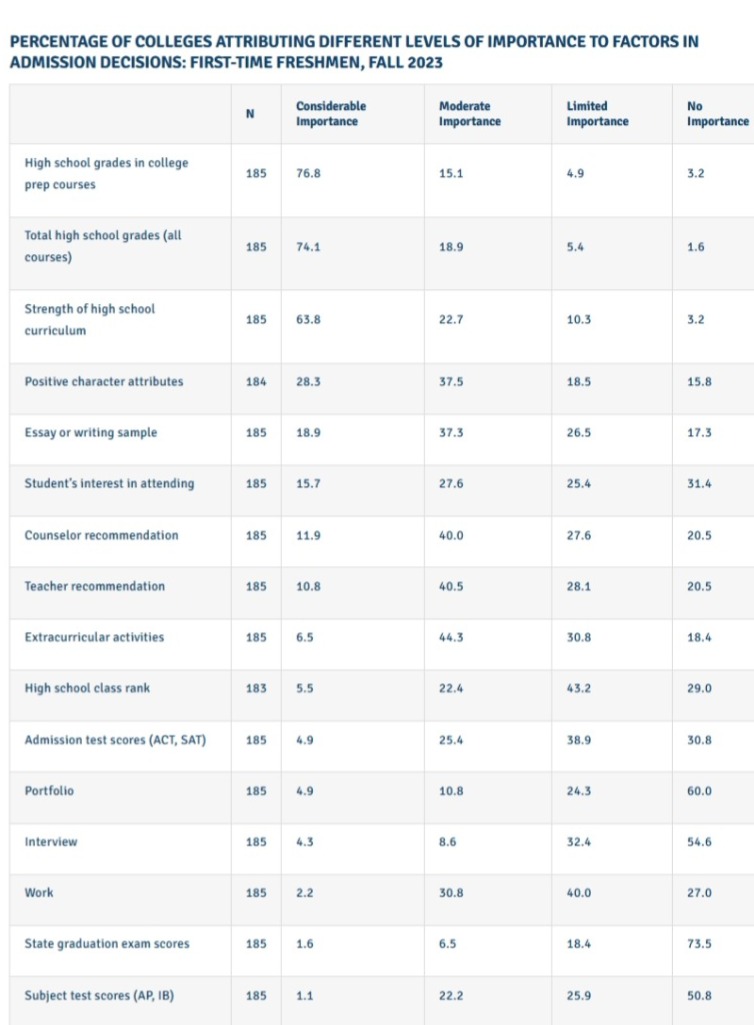
Source: The National Association for College Admission Counseling (NACAC)
Source: The National Association for College Admission Counseling (NACAC)
Colleges look at many things when deciding who to accept — class rank is only one piece of the puzzle. Focus on maintaining a high GPA and challenging yourself in harder classes. When you send in applications, highlight your academic accomplishments and your personal achievements, extracurricular activities, and leadership roles.
Regardless of your class ranking, there’s a perfect college waiting for you. Start your search today with College Raptor’s FREE College Match tool and explore all your options!