Key Takeaways:
- Ivy Plus schools provide quality education programs and experiences that match or even surpass Ivy League offerings.
- Caltech, MIT, and Stanford University are often considered Ivy Plus institutions, but there is no official list.
- Students interested in applying to these schools need top grades, high SAT/ACT scores, and community involvement.
Flickr user Vitor Pamplona
Ivy Plus schools are colleges and universities that offer comparable academics and opportunities to the eight Ivy Leagues. They all have low acceptance rates, are consistently ranked high in the United States, and have produced alumni that have impacted the world. Below, we’ve outlined the 10 institutions that are often named to “Ivy Plus” lists and provided some tips for polishing your applications.
What are “Ivy Plus” schools?
Ivy Plus schools, also known as IvyPlus or Ivy+, are institutions of higher learning that offer education, research opportunities, and experiences on par with (or better than) the Ivy Leagues – Brown University, Columbia University, Cornell University, Dartmouth College, Harvard University, University of Pennsylvania, Princeton University, and Yale University. The term “Ivy Plus” is specifically saying, “There are eight Ivy Leagues, plus these.”
What schools are considered Ivy Plus?
Unlike the Ivy League list, there is no specific definition of what makes a school an Ivy+. Instead, publishers and organizations are free to make their own determinations. These 10 institutions are commonly named to Ivy Plus school lists. In fact, many are also considered “Hidden Ivies” – only Caltech and MIT aren’t. We’ve also included how each institution placed on the College Raptor 2026 Top 50 Best Colleges in the US rankings.

CALIFORNIA INSTITUTE OF TECHNOLOGY
- Location: Pasadena, CA
- Enrollment: 2,427
- Acceptance rate: 2.6%
- 2026 College Raptor Ranking: #5
With a 2.6% acceptance rate, the California Institute of Technology – better known as Caltech – is one of the most, if not the most, difficult schools to get into in the United States. Caltech has produced over 25 Nobel laureates as well as astronauts, company founders, inventors, and researchers. Undergraduates enjoy a 3 to 1 student-to-faculty ratio, and 97% return after completing their first year.
DUKE UNIVERSITY
- Location: Durham, NC
- Enrollment: 17,147
- Acceptance rate: 5.7%
- 2026 College Raptor Ranking: #12
Duke University’s 8,600-acre campus is home to Gothic architecture, Georgian-style architecture, the Duke Forest, marine lab, and more. It’s often considered one of the most beautiful campuses in the country. Duke offers interdisciplinary majors, and many undergraduates choose this route. There are also research projects for all areas of study, and nearly 50% of students study abroad.
JOHNS HOPKINS UNIVERSITY
- Location: Baltimore, MD
- Enrollment: 30,629
- Acceptance rate: 6.4%
- 2026 College Raptor Ranking: #22
Undergraduates at Johns Hopkins University have very small class sizes, with a 6 to 1 student-to-faculty ratio. 98% return after completing their first year, and 87% graduate within four years (95% in six). Students can choose from over 50 academic majors – Cellular and Molecular Biology, Computer and Information Sciences, and Public Health are among the most popular. Johns Hopkins was founded in 1876, making it the oldest research university in the United States.
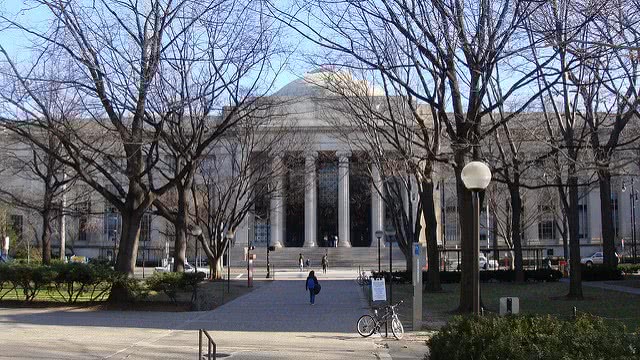
MASSACHUSETTS INSTITUTE OF TECHNOLOGY
- Location: Cambridge, MA
- Enrollment: 11,920
- Acceptance rate: 4.9%
- 2026 College Raptor Ranking: #3
Better known as MIT, the Massachusetts Institute of Technology is all about engineering and physical sciences. Across five subject libraries, MIT has over 2.9 million printed volumes and 2.4 million microforms. The school encourages interdisciplinary study, and many undergraduates major in Computer Science, followed by Mechanical Engineering, Mathematics, and Electronics Engineering.
NORTHWESTERN UNIVERSITY
- Location: Evanston, IL
- Enrollment: 22,892
- Acceptance rate: 7.2%
- 2026 College Raptor Ranking: #14
According to Northwestern University’s website, more than 96% of its “Class of 2024 were employed or pursuing further education or service within six months of graduation.” It was founded in 1851 and is the oldest chartered university in its state. The 240-acre campus is along the shore of Lake Michigan. During the last admissions cycle, accepted students tended to have between a 34 and a 35 on the ACT or between a 1,480 and a 1,560 on the SAT.
RICE UNIVERSITY
- Location: Houston, TX
- Enrollment: 8,771
- Acceptance rate: 8%
- 2026 College Raptor Ranking: #20
Rice University’s 285-acre campus can be founded in the museum district of Houston. It’s a NCAA Division I school, and nearly 400 athletes (known as the Owls) compete in the American Athletic Conference. Over the years, Rice has produced Fulbright Scholars, Nobel laureates, Pulitzer Prize winners, and Rhodes Scholars. Undergraduates have a 5 to 1 student-to-faculty ratio, with many majoring in Computer and Information Sciences.
STANFORD UNIVERSITY
- Location: Stanford, CA
- Enrollment: 18,296
- Acceptance rate: 3.6%
- 2026 College Raptor Ranking: #6
If you thought Stanford University is an Ivy League school, you’re not alone. Many think so! In fact, it was modeled after Cornell University in New York when it was founded in 1885 and was often called the “Cornell of the West.” Alumni include Larry Page, Herbert Hoover, Sergey Brin, Reid Hoffman, Condoleezza Rice, and Reed Hastings. Stanford’s athletic teams have brought home more than 130 NCAA team championships.
THE UNIVERSITY OF CHICAGO
- Location: Chicago, IL
- Enrollment: 18,215
- Acceptance rate: 4.5%
- 2026 College Raptor Ranking: #7
Some alumni of the University of Chicago, or UChicago, include Bernie Sanders, Carl Sagan, Roger Ebert, Eliot Ness, and Liz Cheney. Highly selective, the average submitted weighted high school GPA is 4.97, according to the school’s 2024-2025 Common Data Set. More than 58% of enrolled students had an unweighted GPA of 4.0. Econometrics and Quantitative Economics is the most popular major, followed by Mathematics, Computer Science, and Biology.
VANDERBILT UNIVERSITY
- Location: Nashville, TN
- Enrollment: 13,525
- Acceptance rate: 5.9%
- 2026 College Raptor Ranking: #15
Vanderbilt University has an 8 to 1 student-to-faculty ratio, 96% first year retention rate, and 93% six year graduation rate. It was founded in 1873 and received its current name in 1877 to honor Cornelius Vanderbilt, who donated to the school. There are over 65 undergraduate programs, with many studying Social Sciences. 47% of students choose to study abroad, and there are more than 450 student organizations to participate in.
WASHINGTON UNIVERSITY IN ST LOUIS
- Location: Louis, MO
- Enrollment: 16,453
- Acceptance rate: 12.1%
- 2026 College Raptor Ranking: #23
Students come from all over the world to attend Washington University in St. Louis – more than 110 countries are represented. In fact, 65% of undergraduates come from more than 500 miles away. WashU was founded in 1853 to help meet the need for higher education institutions in the Midwest. It’s a NCAA Division III school, and the Bears have won more than 26 championships.
Tips for applying
Whether you’re applying to an Ivy League, Ivy Plus, or another top ranked school, you need to have a stellar application to increase your chances of acceptance. To improve your chances of a coveted acceptance letter:
- Aim for a high weighted GPA. Rigorous courses increase your weighted GPA if you do well, and colleges like you see you’re prepared for and excelling in advanced coursework.
- Set goals for the ACT/SAT. As with grades, Ivy Plus schools want to see high marks on the ACT or SAT. Review average accepted scores and aim for those. Start studying early, take practice tests, and sit for the exams several times to help you reach your goals.
- Give your application your all. Don’t wing your college applications – to these institutions or any other. Take time to brainstorm and write your essay, think carefully about who you’ll ask for recommendation letters, and practice with mock interviews if your school requires them.
- Apply under Early Action or Early Decision. Many colleges and universities have higher acceptance rates for earlier application processes, such as Early Action or Early Decision. Keep in mind – you should only apply under Early Decision if you are absolutely positive you want to attend. If you’re accepted, you’re expected to enroll.
- Participate in extracurriculars, clubs, and volunteer work. Ivy Leagues and Ivy Pluses are more likely to accept applicants who take part in their community and demonstrate leadership. However, don’t try to join everything under the sun. Focus on your passions and quality over quantity.
With College Raptor’s College Match, it’s easy to see your acceptance chances at these Ivy Plus schools and other institutions that meet your needs and goals. Get started here for free.