Key takeaways
- Grade inflation is when students receive higher grades for work that historically would have earned a B or a C.
- The most common grade in college today is an A-minus. This makes it hard to tell who is truly doing the best work.
- Schools feel pressure to maintain high graduation rates, and some instructors give inflated grades to earn better student evaluations.
- Some colleges are using grade caps and updated college transcripts to help protect the value of a degree.
Flickr user Ludwig
Have you noticed that almost everyone seems to have a high grade-point average these days? That’s grade inflation. It happens when teachers give higher grades for work that is just “okay.” In the past, an A was reserved for the very best students. Now, A-range grades go to many students, even for work that may be merely adequate.
Grade inflation isn’t just a classroom issue. It affects the college admissions process, the value of a bachelor’s degree, and students’ preparedness for the real world.
Where did grade inflation start?
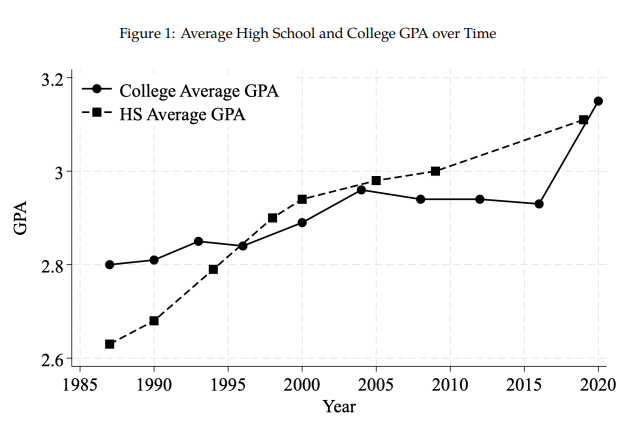
The grade inflation problem isn’t new. It began to take hold in the 1960s and has grown steadily over recent decades. In American higher education, schools like Harvard University and Yale have seen their average GPA climb year after year. According to data tracked by GradeInflation.com, the average GPA at U.S. colleges has risen from around 2.5 in the 1950s to well above 3.0 today. At some selective universities, more than 60% of all grades awarded are now A’s.
The trend isn’t limited to colleges, either. High school grades have followed the same pattern. High schoolers are earning higher grades, but scores on national assessments haven’t risen at the same rate. That gap between grades and test scores is one of the clearest signs of grade inflation.
Source: www.nber.org/papers/w34952

Why are grades rising?
There are several reasons for rampant grade inflation:
- Graduation rates: Lenient grading may help more students pass, which boosts graduation rates and college enrollment numbers.
- Student evaluations: To earn better student course evaluations, some teachers give out easier A’s, even for lesser work.
- College admissions pressure: High schoolers feel enormous pressure to get into a selective college. This can push grades up at the secondary school level, too.
- Competing institutions: When peer institutions inflate grades, other schools may feel pressure to follow. This creates a cycle that’s hard to break.
The effects of grade inflation on students
Grade inflation can create a false sense of how well a student is doing. A student with a high mean GPA may still struggle with basic skills. That gap can be a real shock when they reach advanced courses and find they aren’t as prepared as their transcript suggested.
It also complicates the college admissions process. When almost every applicant has a 3.8 or higher, admissions teams have to rely more heavily on SAT and ACT scores to compare student achievement. And once students graduate, employers may find it harder to use grades as a signal for strong academic performance.
Research from the National Bureau of Economic Research (NBER) suggests grade inflation may even have long-term financial consequences, linking inflated grades in school to lower lifetime earnings.
Arguments for and against grade inflation
Not everyone agrees that grade inflation is a problem. Here’s how both sides see it.
The case against grade inflation:
- It makes a bachelor’s degree harder to distinguish. If every student gets an A, grades stop signaling genuine effort or skill.
- It can leave students unprepared for the workforce. Employers rely on honest assessments to find the right candidates.
- According to The Chronicle of Higher Education, inflated grades may mask weak academic preparation rather than reflect student success.
- There’s less difference between top students and average ones, making it harder to identify standout performers.
The case for more lenient grading:
- Some argue that rising grades reflect students working harder than previous generations.
- Others say that lenient grading reduces student anxiety, supporting student success and mental health.
- There’s also an argument that grades alone were never a perfect measure of ability.
Both perspectives have merit. Most educators agree that grades should reflect actual mastery of course material, not just effort or attendance.
How schools are addressing grade inflation
Some institutions are already taking steps to push back. Princeton University and Wellesley College have experimented with limiting how many students in a class can earn an A. Harvard University has also recently discussed similar policies.
Other schools are updating their college transcripts to include the median grade for each class. This gives employers and graduate programs more context. A student who earned a B in a course where the median was a C+ may actually have performed very well.
The use of standard deviation in grade reporting is another tool some schools are exploring. By showing the spread of grades in a course, schools can help outside observers understand whether a high grade was difficult to earn.
How to help stop the grade inflation trend
Fixing the grade inflation problem takes effort at every level. Here are some steps institutions can take that may help:
- Set clear, consistent standards for what earns an A and stick to them.
- Give instructors meaningful feedback and support so they feel confident giving honest assessments.
- Focus evaluations on actual mastery of course content, not just completion.
- Update college transcripts to include grade distribution data so context is always visible.
- Support faculty autonomy so instructors can grade fairly without fear of poor student evaluations.
Why grade inflation matters
Keeping grades honest protects the value of education for everyone. When grades reflect true academic achievement, students, employers, and institutions can all trust them.
If you’re navigating the college admissions process, understanding grade inflation may help you put your own academic record in context and find schools that are the right fit for your goals.
Use College Raptor’s College Match tool to explore colleges based on your academic profile, and check out our Best Colleges rankings to find schools with strong academic reputations.